"In Xinjiang, I Found My Spiritual Home"

Xinjiang covers about one-sixth of China's total land area. It borders eight countries, making it China's largest provincial-level region, the one with the most neighboring countries, and the longest land borders.
Here, people of different ethnic groups watch over one another, weaving together vibrant scenes of everyday life.
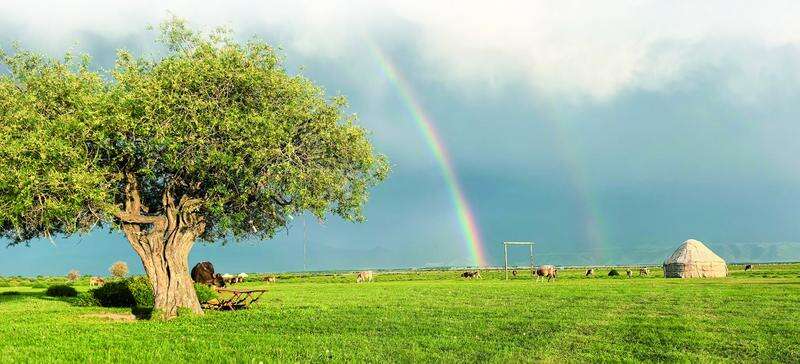
From rainbows over the RainbowBulaq Pasture in Xiata, to the bumper harvests in the "super cotton fields" of Yuli County; from the transformation of Karamay's barren Gobi into a modern city, to the rhythm of openness brought by China-Europe freight trains—Xinjiang's beauty is a living blend of tradition and modernity, the resonance of natural splendor with rich cultural heritage, and the warmth of development benefits reaching thousands of households.
Bathed in sunlight, Xinjiang awaits more people to measure it with their footsteps and listen with their hearts.
"Herding My Heart" on the Ili River
In early summer, a sudden thunderstorm broke the calm of the RainbowBulaq Pasture in Xiata, Ili. Dark clouds rolled in, thunder rumbled. Herdsmen sprang into action, quickly tightening the ropes over their yurts and gathering loose belongings. In the distance, clouds and sunlight met at the horizon, with snowcapped peaks, green meadows, cattle, and sheep merging into a unique pastoral poem of life.
"By the Ili River, the herders are tending their flocks, and I am tending my heart," said He Lei, founder of the Ili Bamboo HorseCultural Tourism Development Company.
In 2008, driven by the question "Just how beautiful is Ili?", he set out for this river valley in far-western Xinjiang. His journey westward was a long traverse of yellow sands and barren land. But stepping into the Ili River Valley felt like entering a classical Chinese landscape painting.
Snow gleamed on mountaintops like veils on celestial maidens; spruce forests grew lush between the ridges; herds of cattle and sheep roamed the vast green "carpets" on the hillsides; below, the Ili River surged alongside patchwork fields of vegetables, rapeseed flowers, and lavender—an idyllic palette of greens, golds, and purples.
"Every view was heartbreakingly beautiful," he recalled. Abundant rainfall—thanks to the unique terrain between the northern and southern Tianshan ranges—has earned Ili the nickname "a Jiangnan beyond the Great Wall." As a key node on the ancient Silk Road, it has for centuries been a meeting place for multiple ethnicities and cultures, creating a unique and enchanting local character.
A Land of Many Peoples
When the flowers bloom, visitors to a Uyghur family's home find tidy courtyards shaded by grape arbors and framed by colorful flowers, with walls painted in bright hues—a testament to the residents' love of life and creative spirit.
"The more different we are, the freer we are," he said. Xinjiang is home to dozens of ethnic groups—including Uyghur, Han, Xibe, and Mongol—where nomadic and agrarian cultures meet, and each group preserves its distinct traditions. Different Peoples appreciate and respect one another, embodying sociologist Fei Xiaotong's vision: "One should value not only one's own culture, but also the cultures of others, and this will contribute to the flourishing of all cultures."
He came to Xinjiang as a tourist, but stayed on as an entrepreneur—his company, Bamboo Horse, is his "love letter" to Ili. For him, cultural tourism is not just "culture + sightseeing," but a way to explore Xinjiang's diversity and the wisdom of its many peoples. "I want to tell the stories of this land so that when people stand before Ili's grand landscapes, they can also feel the distinctive charm of cultural fusion."
Time Moves Differently Here
Every May, more than 60 herding households drive their livestock to Bulaq Pasture and remain there until October, far from the noise of the city, living an authentic nomadic life.
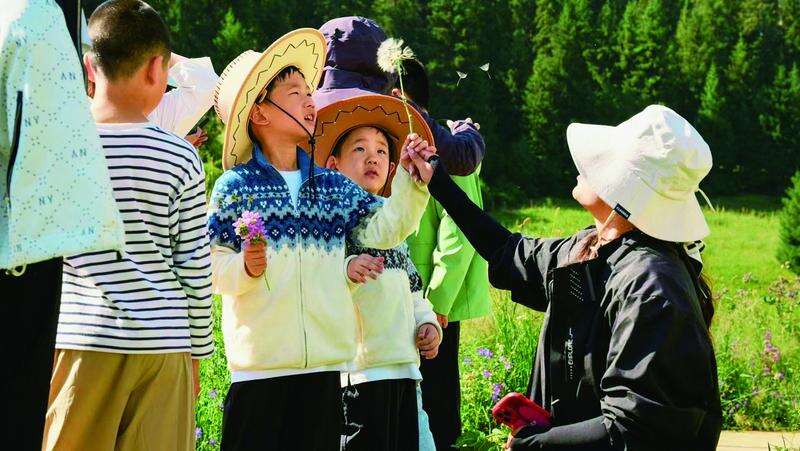
"Here, time seems to be redefined," he explained. His "mobile classroom" travel program in the Ili Valley offers over a hundred immersive experiences—horseback riding across meadows, herding sheep with Kazakh herders, brewing kvass from bread and wheat husks, hand-stitching leather horsewhips—each encouraging participants to set aside their phones and worries, reconnect with nature and with life's slower rhythms.
In the city, people live on tightly scheduled calendars, driven by deadlines and to-do lists. "But in the pasture," he joked, "the phrase right away' means something else entirely."
Once on horseback, a herder might return in ten minutes—or two hours, under a sunset sky. At first, he found this "lack of time consciousness" puzzling. Gradually, he began to ask himself: what is life really about?
On the grasslands, the answer lies in the simplest things: moving with the seasons, cooking when hungry, resting when tired. "And that's just fine," he said.
Lessons for the Future
Parents often bring their children here, seeking growth beyond school walls. In an era of rapid AI development, what does it mean to live as a human being? Experiencing Xinjiang's cultural diversity may offer clues.
When children see herders living in harmony with nature, hear laughter mingling with birdsong, and witness different cultures blending together, they begin to grasp the meaning of the seasons and the beauty of coexistence. Nomadic life encourages them to find their own rhythm amid the meeting of civilizations. This, he believes, is Xinjiang's greatest gift to travelers.
"Connecting with a place's history and culture—that's what travel should be," he said. His Ili Valley programs are like dandelion seeds: "You don't have to decide where each seed will land; it will take root where the soil is right."
Growing Roots in Ili
In recent years, he has built several distinctive tourism camps in Ili. In 2022, his company opened a nearly 500-square-meter Intangible Cultural Heritage Experience Center in Liuxing Street, where six representative inheritorsteach visitors traditional crafts. In 2023, the "JiasaganXiata Theme Camp" opened at the entrance to the Xiata Trail. In 2024, the "Bulaq Nomadic Experience Base" welcomed its first visitors.
Over eight years, the Bamboo Horse team has guided more than 7,000 families from across China into the Ili Valley, helping local herders increase their income and improve their lives.
A horsewhip-makingworkshop offers a close-up of nomadic heritage; a steaming bowl of wild mushroom soup holds the flavors of Xinjiang cuisine; an evening bonfire dance reflects the emotional pulse of many peoples. For him, immersive travel is the future of tourism—and a way to rediscover life's tempo, forging a gentle connection between humans and nature.
"In Xinjiang, I have found peace of mind. I have found my spiritual home," he said.(By Zhao Tingting, Yuan Ye, Wang Xueyingand Fu Rui/China Youth Daily)